
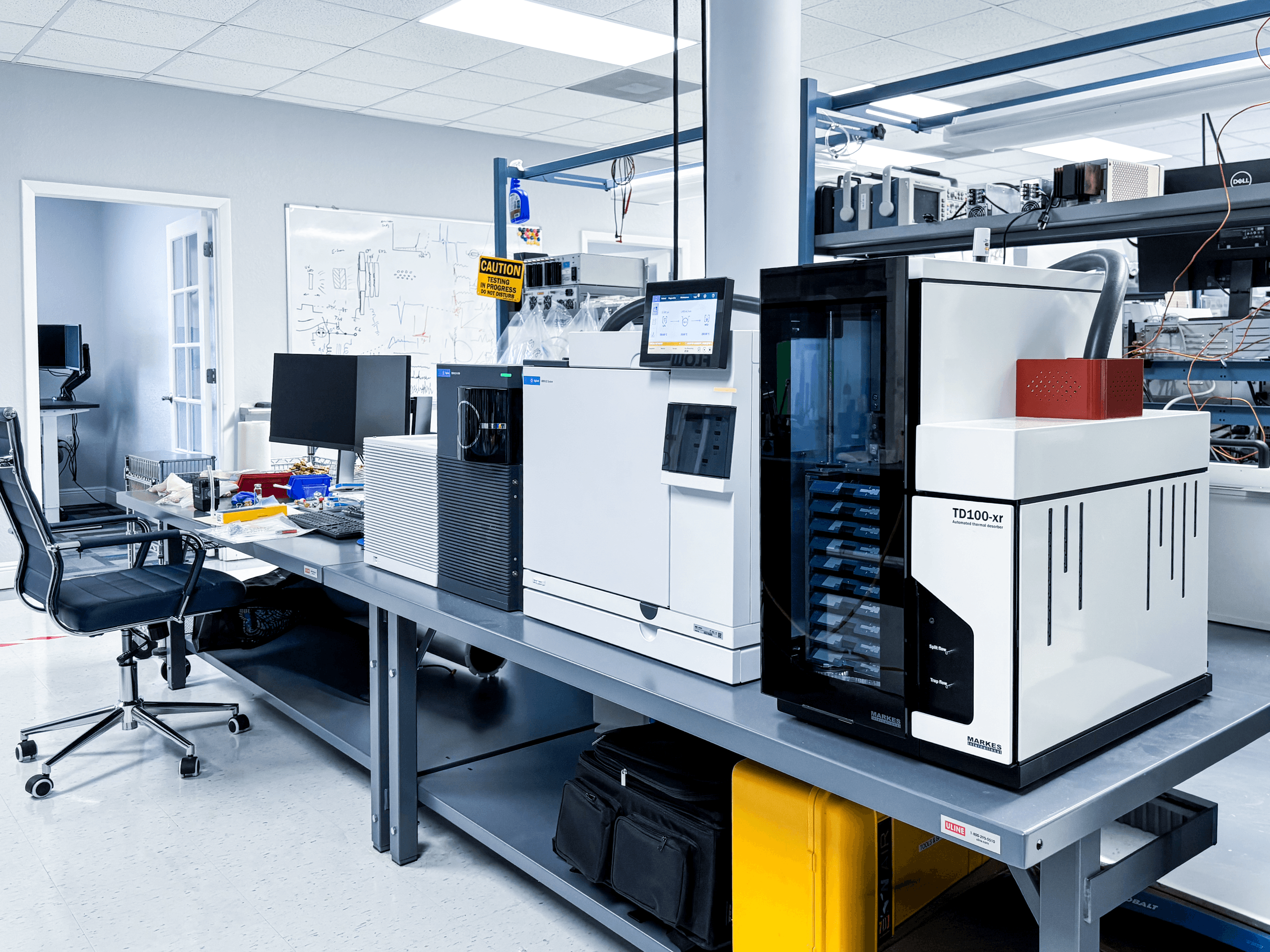
Detect-ION Lab in Tampa, FL
High Resolution Mass Spectrometry
The Reference Standard Behind Every BreathWhy Detect-ION built its science on High Resolution Mass Spectrometry?
CLARION was designed to bring diagnostics to the patient: a portable gas chromatography–mass spectrometry platform that analyzes the volatile chemistry of a rapid, non-invasive breath collection (on the order of two minutes) at the bedside, in the clinic, or in the field. The value of a point-of-care measurement, however, depends entirely on the analytical foundation beneath it. At Detect-ION, that foundation is high resolution mass spectrometry (HRMS): the reference method we use to establish, test, and periodically re-confirm what CLARION measures, so that a rapid result never rests on assumption.
What is High Resolution Mass Spectrometry?
Every mass spectrometer rests on a single principle. A molecule is ionized (given an electrical charge), and the instrument measures its mass-to-charge ratio (m/z), effectively weighing the molecule with high precision. Coupled to gas chromatography, which separates a mixture into its individual components by their transit time through a column, the combination yields a two-dimensional descriptor for every compound in a sample: when it elutes, and what it weighs.
The word that matters is resolution. A conventional, unit-resolution instrument reports a compound's nominal mass, enough to say a molecule weighs “about 204.” A high resolution mass spectrometer resolves that same measurement to several decimal places, and that extra precision is often the only thing standing between a correct answer and a wrong one. Consider two molecules that both weigh approximately 204 amu, one built around a nitrogen atom, the other built around a carbon-and-hydrogen group in its place. Their exact masses differ by only about 60 parts per million, a gap invisible to a unit-resolution instrument, but one a high-resolution system resolves cleanly. Get that call wrong, and you don't just mislabel a peak; you mistake one class of compound for another entirely. With accurate mass at this level, we can assign a molecule's elemental formula, separate compounds that overlap or co-elute, and identify a trace signal with a level of confidence that a lower-resolution instrument simply cannot offer.
Where does CLARION sit on that spectrum? CLARION is a unit-resolution instrument, resolving to approximately 1 amu — nowhere near HRMS, and not intended to be. Its resolving power is comparable to the benchtop GC-MS systems used routinely for confirmatory chemical identification, and it identifies compounds the way those systems do: not by exact mass, but by matching two independent descriptors at once, chromatographic retention time and the full mass spectral fragmentation signature of the compound. That combination is specific enough to support confirmatory identification, but only against a rigorously developed chemical library. Every target compound must first be characterized on the reference instrument and entered into CLARION's library before the portable platform can call it in the field, which is why reference-grade chemistry is a prerequisite for a rapid result rather than a parallel activity.
Both tracks share the same measurement architecture: in our workflow, HRMS and CLARION alike are configured as thermal desorption gas chromatography–mass spectrometry (TD-GC-MS) systems, differing in resolving power and portability rather than in approach. Thermal desorption concentrates and releases the very low quantities of volatile organic compounds collected onto sorbent media from breath, urine headspace, or skin; gas chromatography separates them; and high-resolution MS identifies each with defensible confidence. The result is the conversion of a faint, chemically complex sample into an annotated inventory of molecules, the ground truth on which the rest of the program depends. In practice, CLARION's breath analysis is capable of supporting independent VOC model development on its own data, but we almost always corroborate those models against the HRMS track. That is why we stand boldly behind the diagnostic claims we make for CLARION.
How is HRMS breath specimen collected?
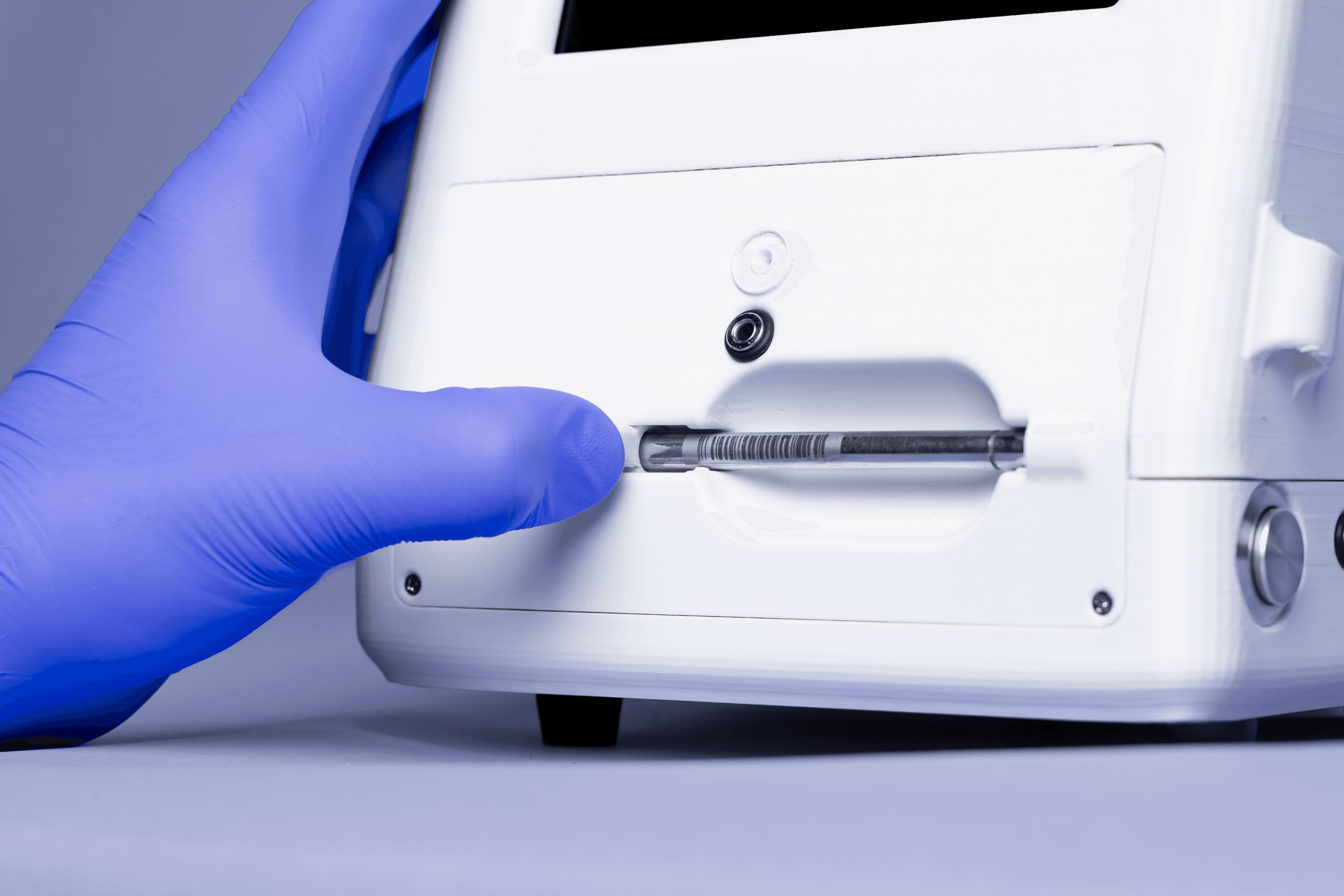
CLARION is equipped to collect paired breath specimens directly onto commercial sorbent tubes, the same media used on the HRMS track. Breath is captured exhalation by exhalation, with each exhalation split so that one portion is analyzed onboard while its exact counterpart is retained on a tube for reference-grade analysis. The approach forgoes cumbersome Tedlar bags and costly dedicated breath-collection apparatus, and it matches the two datasets at the level of the individual breath, so raw breath data, biomarker assignments, and VOC models
align exactly between CLARION and HRMS.
Why the volatileome demands this level of rigor?
The compounds of diagnostic interest, the body's volatilome, occur at parts-per-billion concentrations or below, superimposed on a background of hundreds of other volatiles arising from endogenous metabolism, diet, the environment, and the sampling apparatus itself. Metabolic, inflammatory, infectious, and oncologic processes each perturb this profile, but the resulting signals are readily misread: an apparent biomarker may in fact be a co-eluting interferent, a contaminant, or an artifact of collection.
Errors introduced at this stage are costly because they are silent. A misidentified compound, or a feature that is not reproducible, propagates unchallenged into every downstream model and clinical claim. HRMS constrains that risk directly. When the reference instrument reports a specific aldehyde, ketone, or sulfur-containing compound, the assignment is supported by accurate mass and corroborated against spectral libraries and, where available, authentic standards: an identification, not an annotation of convenience.
Accelerating CLARION development
HRMS does not compete with speed of development; it is what makes disciplined speed possible.
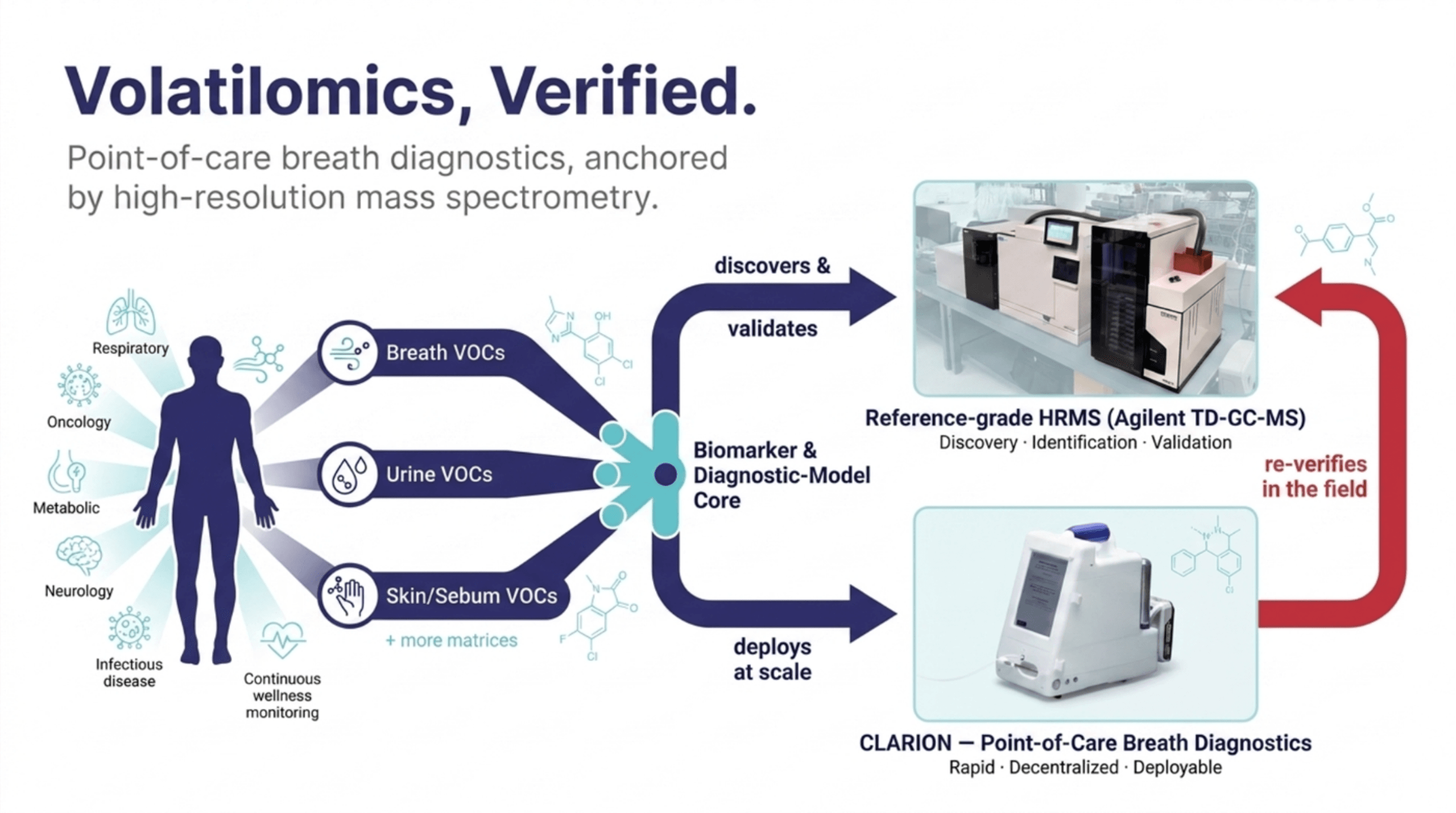
HRMS is where biomarker discovery is performed. Operating in untargeted mode, HRMS surfaces the volatile compounds that genuinely differ between clinical groups without pre-specifying the targets. These findings define CLARION's analytical requirements: which compounds the portable platform must detect, at what limits of detection, and against which interferences, converting an open design space into a concrete specification.
It is equally where methods are developed and hardened. Sampling protocols, sorbent chemistry, chromatographic conditions, and the acquisition windows CLARION depends on are established and stress-tested first on the bench, where resolving power makes it possible to determine whether a method performs as intended. The reference platform then serves as the orthogonal comparator for the portable system: each CLARION result can be evaluated against it to assess agreement. That head-to-head comparison is how CLARION's sensitivity, selectivity, and accuracy are quantified before the platform is relied upon in the field.
Underwriting clinical validation
Clinical validation depends on the defensibility of its underlying evidence, and this is where HRMS is most consequential. Regulators, clinical collaborators, and reviewers do not accept detection alone; they require confident compound identification, reproducible and documented methods, and traceable comparison to an accepted reference. Accurate-mass identification supplies that evidentiary basis.
The reference platform also produces the well-characterized, accurately labeled data used to train and test our diagnostic models. A classifier is bounded by the quality of its labels; when those labels derive from high-resolution measurements, the resulting models rest on verified chemistry rather than ambiguous features. As CLARION progresses through clinical study, the reference instrument continues to run in parallel, confirming findings, monitoring for analytical drift, and supplying the corroborating measurements that move a candidate signal toward validated clinical performance.
A closed loop, not a one-way pipeline
The two instruments are related by design. HRMS discovers and validates the biomarkers and models; CLARION deploys them at the point of care, where speed and accessibility determine real-world utility; and results generated in the field are returned to the reference platform for confirmation, informing the next cycle of discovery. Analytical rigor and clinical reach are coupled rather than traded against each other.
For this reason, Detect-ION treats HRMS as foundational analytical infrastructure rather than an ancillary tool. It is what allows a CLARION measurement to be both rapid and reliable: behind a roughly two-minute breath collection stands a body of reference-grade chemistry that has already addressed the central question in any diagnostic measurement – whether the analyte being reported is, in fact, the analyte present. That assurance is what we extend to our partners, our clinical collaborators, and the patients their work ultimately serves.
No question too small
Building a breath, urine, or skin VOC biomarker program, or any volatilomics application?
We can help you do it on reference-grade chemistry. Co-develop a diagnostic panel.
Validate against our HRMS platform. Put CLARION to work outside the clinic.
Tell us what you're trying to measure, and we'll tell you what it takes.