
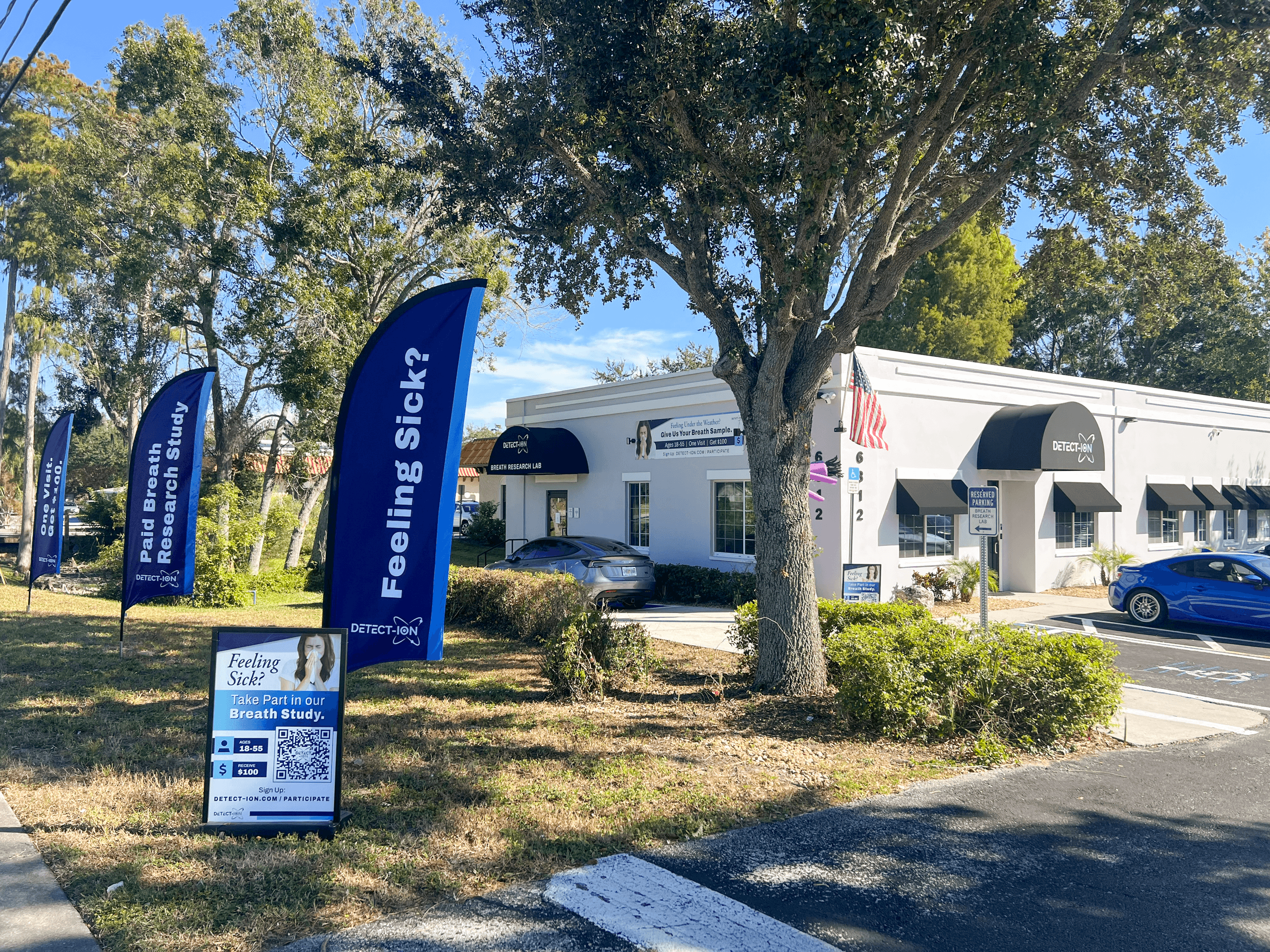
Breath Research Laboratory at Detect-ION
Breath Research Laboratory
Breath Diagnostics, Under One RoofWhy Detect-ION opened an onsite Breath Research Laboratory?
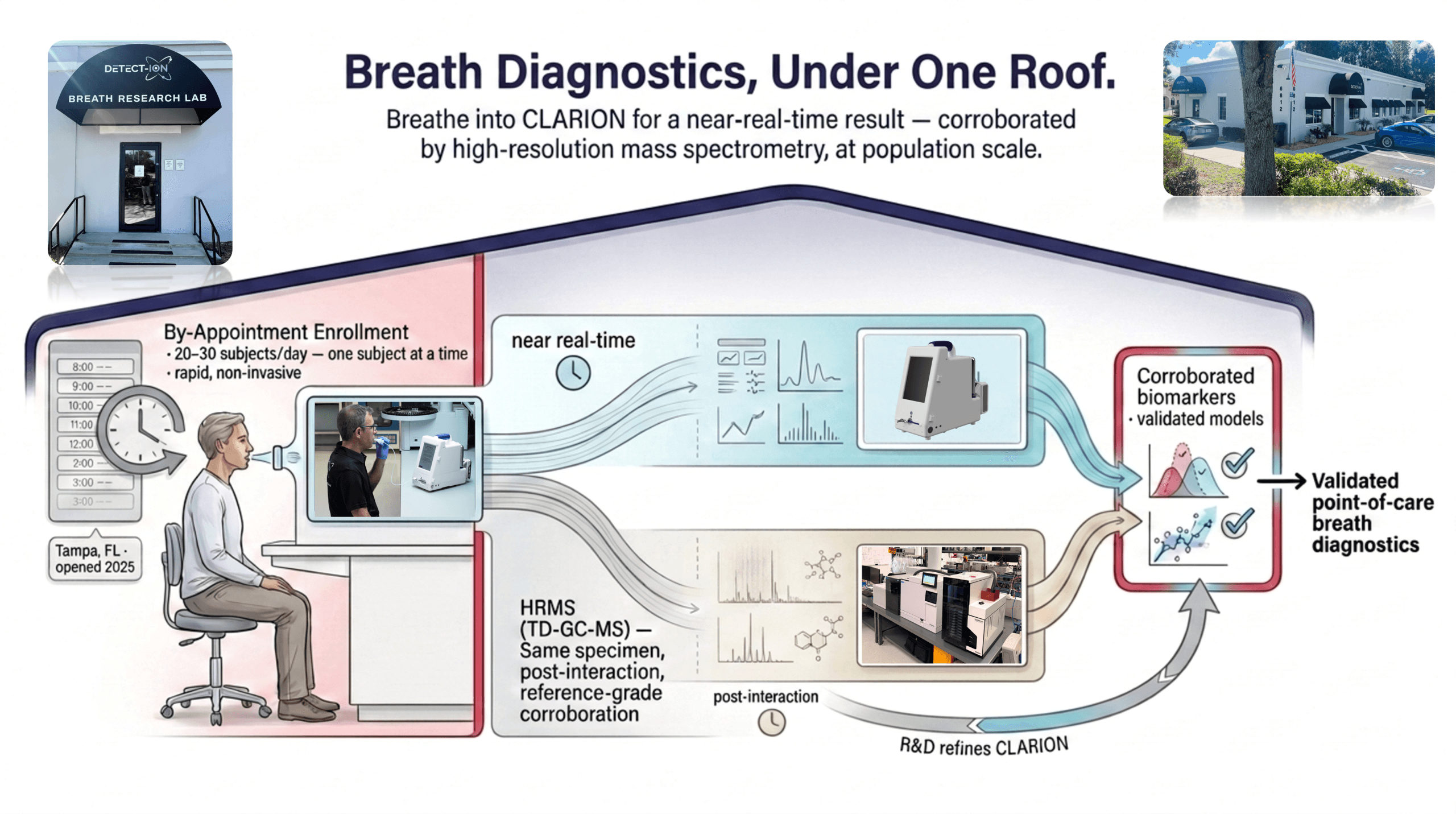
In September 2025, Detect-ION opened a dedicated Breath Research Laboratory (BRL) at its Tampa, Florida headquarters, a deliberate move to bring biomarker discovery, instrument engineering, and clinical study together in a single facility. Breath-based diagnostics sit at the intersection of analytical chemistry, hardware engineering, and clinical science, and progress depends on how quickly those disciplines can inform one another. By co-locating them under one roof, the lab was built to shorten that feedback loop and accelerate the path from a measured molecule to a validated point-of-care test.
A facility built around breath
The Breath Research Laboratory occupies Detect-ION's 4,000-square-foot headquarters and integrates three capabilities that ordinarily live in separate organizations. At its analytical core is high-resolution mass spectrometry (HRMS), the reference-grade method used to identify and confirm the trace volatile organic compounds that carry diagnostic meaning. Alongside it sits a research-and-development laboratory for method development and sample handling, and a rapid-prototyping shop where instrument hardware can be designed, built, and revised on site.
That combination is the point. Analytical chemists, engineers, and clinical staff work in the same space, on the same samples, within the same week, rather than shipping specimens to outside contract labs and waiting on turnaround. The onsite instrumentation supports both untargeted discovery, in which the analysis is allowed to reveal whatever volatile compounds differ between groups, and targeted confirmation, in which specific compounds of interest are measured and verified against reference standards. The facility was also designed with clinical research in mind: located minutes from Tampa International Airport, with a private entrance for study volunteers, it accommodates human breath-sample collection in a controlled, purpose-built environment that minimizes the pre-analytical variability, in collection, handling, and timing, that can otherwise obscure a genuine signal.
Collapsing the distance between discovery and the clinic
The strategic value of an onsite lab is speed of iteration under direct oversight. When a breath study surfaces a candidate biomarker, the compound can be characterized on the reference instrument, the sampling and analytical methods can be refined in the R&D lab, and any required hardware change can be prototyped down the hall, without the delays and hand-offs that fragment a program spread across multiple sites.
Bringing the lab in house materially improves the company's operational agility: it strengthens oversight of research processes and allows the team to iterate rapidly on new clinical strategies. In practice, that means fewer phase delays, tighter control over study operations, and real-time integration of data as it is generated, so decisions are made on current evidence rather than on results that are weeks old. For a young diagnostics company, compressing that cycle is one of the most effective ways to convert investment into validated capability.
From reference chemistry to point-of-care
The laboratory is where Detect-ION's two-tier analytical strategy is executed day to day. High-resolution mass spectrometry serves as the reference standard: it discovers which volatile compounds distinguish health from disease and confirms their identities with accurate-mass measurement, establishing the chemical ground truth for the program. Those findings then define the requirements for CLARION, Detect-ION's portable, point-of-care breath-diagnostics platform, which aims to deliver accurate, affordable, and non-invasive respiratory-infection screening using chip-scale mass spectrometry.
Housing both the reference instrumentation and the prototyping capability in one place makes the relationship between them practical rather than aspirational. Targets identified by HRMS inform what the chip-scale platform must detect; CLARION prototypes can be measured directly against the reference method; and discrepancies can be diagnosed and addressed in the same facility. The lab is, in effect, the workshop in which discovery on the bench is translated into a deployable instrument and continually checked against the standard that produced it.
Clinical studies, run onsite
Beyond development, the Breath Research Laboratory functions as a clinical research hub for breath-diagnostic studies, with an emphasis on non-invasive screening for respiratory illness. Running studies onsite gives Detect-ION direct control over sample collection, handling, and analysis: the stages where variability is most easily introduced and where standardization most directly affects the quality of the resulting data.
The lab supports Detect-ION's participation in the EXHALE program, a federal effort advanced by the Defense Threat Reduction Agency (DTRA) and the Defense Innovation Unit (DIU) to develop rapid, non-invasive breath-based screening. With the facility operational, the company has been preparing to launch a second campaign of its breath-diagnostic study, drawing on volunteer participants recruited through its enrollment program. Each study generates paired data (breath samples analyzed against the reference method) that both validate the diagnostic models and feed the next round of refinement.
Why the investment matters?
Detect-ION's decision to build rather than outsource reflects a view about where diagnostic programs succeed or fail. The hardest problems in breath diagnostics are not solved by any single measurement; they are solved by the ability to move quickly and repeatedly between chemistry, engineering, and the clinic while keeping conditions controlled and evidence current. An onsite laboratory makes that iteration a routine part of operations rather than a coordination exercise across vendors and locations.
The result is a facility that supercharges the company's breath-diagnostics ambition on several fronts at once: it anchors the science in reference-grade high-resolution mass spectrometry, it shortens the development cycle for the CLARION platform, and it provides a controlled, well-instrumented environment for the clinical studies that ultimately determine whether a breath test performs. Bringing discovery, development, and validation under one roof is how Detect-ION intends to turn the promise of non-invasive breath diagnostics into tests that clinicians and patients can rely on.
We've got it from here
Looking for an experienced clinical enrollment partner? Need reference-grade HRMS analysis of breath, urine, or skin VOC samples? Facing IRB or protocol hurdles? We are here to help.
Tell us what you're trying to study, and we'll tell you what it takes.